
How Slippage Silently Kills Your Crypto Trading Returns — And How to Fix
A guide to execution quality for institutional and algorithmic crypto traders | BlockFill
Key takeaways
- Slippage is the difference between the price you expected and the price you actually got. It grows with order size because large orders consume several levels of the order book.
- To reduce it on large crypto orders, avoid single market orders: split execution over time, check order-book depth, and use an execution algorithm that adapts to liquidity.
- Measure execution quality against the arrival price, not just fees. Selsus BlockFill is QSG’s execution algorithm built to reduce slippage on large orders.
The Cost Nobody Puts on the P&L
Every serious trader tracks fees. Most track funding rates. Few rigorously track slippage — and that oversight is often far more expensive than the costs they do measure.
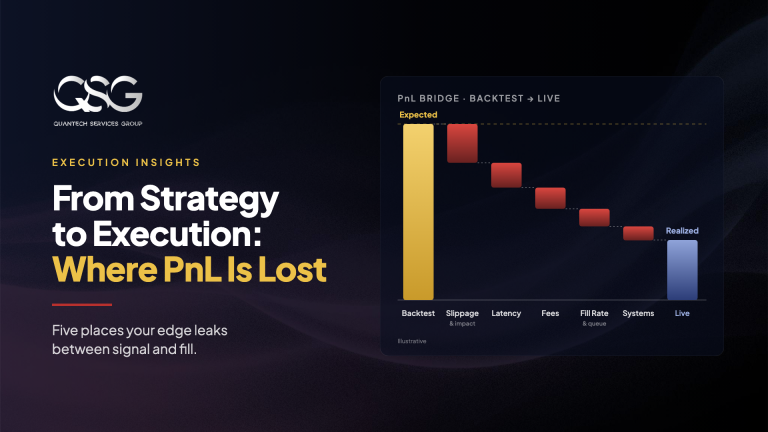
Slippage is the gap between the price you intended to trade at and the price you actually received. In theory it sounds like a rounding error. In practice, for anyone operating with meaningful size, slippage is one of the largest and most controllable costs in a trading operation — yet it routinely goes unaddressed because it is embedded in execution rather than reported as a line item.
This article breaks down why slippage happens, why it matters more than most traders realize, and how BlockFill’s execution infrastructure is built to systematically reduce it across the leading crypto exchanges.
Why Slippage Happens: The Mechanics
To understand slippage, you need to understand how order books actually work. Every exchange operates a continuous double auction — buyers post bids, sellers post asks, and trades occur when the two sides meet. The visible price on your screen represents only the top of that book: the best available bid and ask at a given moment.
When you submit a market order, it does not fill entirely at that top price. It sweeps through multiple levels of the book, consuming whatever liquidity is available at each price point until the full order is filled — or until it runs out of liquidity and sits incomplete. Every level below the best ask that your order consumes represents additional slippage.
For a small order in a liquid market, this effect is negligible. But for larger orders — or in thinner markets, or during periods of elevated volatility — the difference between the expected and realized price can be dramatic. And because crypto markets can experience significant intraday liquidity shifts, even established trading pairs on top exchanges are not immune.
There are also subtler forms of slippage. Latency between decision and execution means the market may have moved in the time it takes your order to reach the exchange. Partial fills followed by re-entry create a different kind of realized price than a single clean fill. And in some market conditions, simply the act of placing a large visible order telegraphs intent to other participants, causing the market to move against you before you have finished executing.
The Scale of the Problem for Large Orders
Individual retail trades are often too small for slippage to matter meaningfully. But once order size begins to represent a significant fraction of the available liquidity at the top of the book, the dynamics change.
Consider a fund that needs to acquire a substantial position in a mid-cap crypto asset. Even on a major exchange, the bid-ask spread may be narrow but the book depth beyond the top few levels may be limited. Executing the full order in a single market sweep could push the realized average price significantly above the intended entry — a cost that directly reduces the strategy’s returns before any other factor is considered.
For systematic strategies that execute repeatedly — accumulation programs, rebalancing schedules, algorithmic portfolios — this cost compounds across every cycle. A strategy that looks attractive on paper may chronically underperform its theoretical returns simply because execution is not treated with the same rigor as signal generation.
This is the problem BlockFill is built to solve.issed opportunities and worse execution prices.
What Professional Execution Actually Looks Like
Institutional execution desks at major banks and hedge funds have spent decades developing execution algorithms — TWAP (time-weighted average price), VWAP (volume-weighted average price), implementation shortfall minimization, and more sophisticated adaptive approaches. These tools exist precisely because execution quality is understood to be a source of alpha erosion, and controlling it is treated as a serious operational discipline.
Crypto markets have largely not caught up to this standard. Many trading operations — even sophisticated ones — still rely on manual execution or basic exchange order types that do not account for market microstructure. The opportunity cost of this gap is significant.
BlockFill brings institutional-grade execution discipline to crypto, combining two core capabilities:
- Short-term price prediction models: Using quantitative models trained on real market data, BlockFill forecasts near-term price movements and order book dynamics. This allows the system to time order placement intelligently — being patient when conditions are unfavorable and moving decisively when the model signals a favorable window. Execution is not just about how you trade, but when.
- Adaptive order fragmentation and routing: Rather than placing a single large order that announces intent and sweeps liquidity, BlockFill breaks orders into optimally sized child orders, distributing them across time and price levels. Execution pace and aggressiveness adapt dynamically to real-time market conditions, not a fixed algorithm that ignores what the market is doing.
The combination means that orders are executed in a way that works with market structure rather than against it — minimizing both direct market impact and adverse selection from other participants.
Multi-Exchange Coverage: Where BlockFill Operates
Liquidity in crypto is fragmented across multiple venues. No single exchange has a monopoly on depth for every asset, and the best execution for a given order often means accessing multiple pools of liquidity rather than committing to a single venue.
BlockFill currently supports execution across the leading centralized exchanges: Binance, OKX, Gate, KuCoin, Bybit, and Bitget — and the list continues to expand. This multi-venue capability matters for two reasons.
First, it allows BlockFill to route orders to wherever liquidity conditions are most favorable at the time of execution. For assets that trade across multiple exchanges, this can meaningfully improve realized prices compared to single-venue execution. Second, for clients who already operate across multiple exchanges, BlockFill provides a unified execution layer rather than requiring separate management of each venue.
Infrastructure is co-located and optimized for the latency requirements of professional execution — not the latency tolerances of retail interfaces.
Who BlockFill Is Built For
BlockFill’s execution infrastructure is designed for two primary client profiles, each with distinct needs around slippage reduction:
Large single-order execution
Clients who need to acquire or exit a significant position in a single operation — a token unlock, a portfolio entry or exit, a directional trade requiring meaningful size. The challenge is consistent: how do you move from intention to full execution without the act of executing itself moving the market against you? BlockFill’s models and fragmentation engine are designed specifically for this scenario, allowing large orders to be absorbed into the market progressively without telegraphing intent or sweeping liquidity destructively.
Systematic and scheduled execution programs
Quantitative funds, algorithmic portfolios, and treasury management programs that execute on a regular schedule — weekly rebalancing, daily accumulation, monthly distributions. For these clients, execution quality is not a one-time optimization but a continuous operational factor. Small improvements in realized price compound significantly across hundreds or thousands of execution events. BlockFill provides consistent, optimized execution across the full program rather than treating each trade in isolation.
In both cases, the underlying need is the same: to bridge the gap between the price a model or strategy assumes and the price that is actually realized in the market.
The Team Behind BlockFill
BlockFill is built by a team with deep practical experience at the frontier of crypto market structure. Our trading history includes reaching Binance VIP9 status and operating as a top-tier market maker on Binance — credentials that reflect both the volume of activity and the execution sophistication required to operate at that level.
Market making at this scale demands an intimate understanding of how order books behave, how liquidity providers and takers interact, and how execution decisions ripple through market microstructure. This is not theoretical knowledge — it is operational understanding built through years of live exposure in real markets.
That foundation is what BlockFill’s execution models are built on. The same principles that govern how we manage our own execution are embedded in the infrastructure we provide to clients.
Execution Is Alpha — Treat It That Way
There is a common framing in quantitative finance that separates alpha generation (the signal) from execution (the plumbing). This framing is misleading. Execution is not plumbing — it is a direct multiplier on the value of every signal a strategy generates.
A strategy with a genuine edge that loses 0.3% per trade to unnecessary slippage will chronically underperform. The same strategy with tight execution will deliver materially better risk-adjusted returns — not because the signal improved, but because more of it is captured in realized P&L.
As crypto markets mature, this understanding is becoming more mainstream among professional trading teams. The firms that treat execution as a source of competitive advantage — not just a cost center — are the ones that will compound returns more effectively over time.
BlockFill exists to give trading operations that edge without requiring them to build the infrastructure themselves. Whether you are managing a fund, running a systematic strategy, or executing large single trades, the question of how you execute deserves the same analytical rigor you apply to everything else.
Work With BlockFill
If slippage is a known cost in your current operations — or if you suspect your realized prices are consistently worse than your intended prices — we would like to understand your execution needs and show you how BlockFill approaches the problem.
We work with clients across the full range of crypto trading operations, from individual large-order execution to ongoing institutional programs. Reach out to the BlockFill team to start a conversation.